Dedicated Mobile App Development Team: When Do You Need One?

A dedicated mobile app development team is a good choice when your product needs more than a one-time build. If the app has a long roadmap, frequent releases, complex features, or continuous user feedback, hiring developers only for a fixed project may not be enough.
Many companies start with a simple goal: build an app and launch it. But after the first version, the product usually needs improvements, bug fixes, analytics review, new features, backend updates, App Store and Google Play changes, performance optimization, and user experience improvements. This is where a dedicated team becomes valuable.
A dedicated mobile development team works as an extension of your business. Instead of hiring separate freelancers or restarting vendor selection for every new feature, you get a stable group of specialists who understand your product, codebase, users, business logic, and long-term goals.
This model is especially useful for startups after MVP validation, SaaS companies with mobile products, enterprise teams, marketplaces, fintech apps, healthcare platforms, fitness apps, logistics products, and companies that need regular mobile development capacity.
TopDevs provides mobile app development services for companies that need dedicated mobile app developers, full-cycle product teams, and long-term support for iOS, Android, and cross-platform applications.
What Is a Dedicated Mobile App Development Team?
A dedicated mobile app development team is a group of specialists assigned to your product for a longer period of time. They are not hired for one isolated task. They work continuously on your mobile application, usually following your roadmap, sprint cycles, business priorities, and product goals.
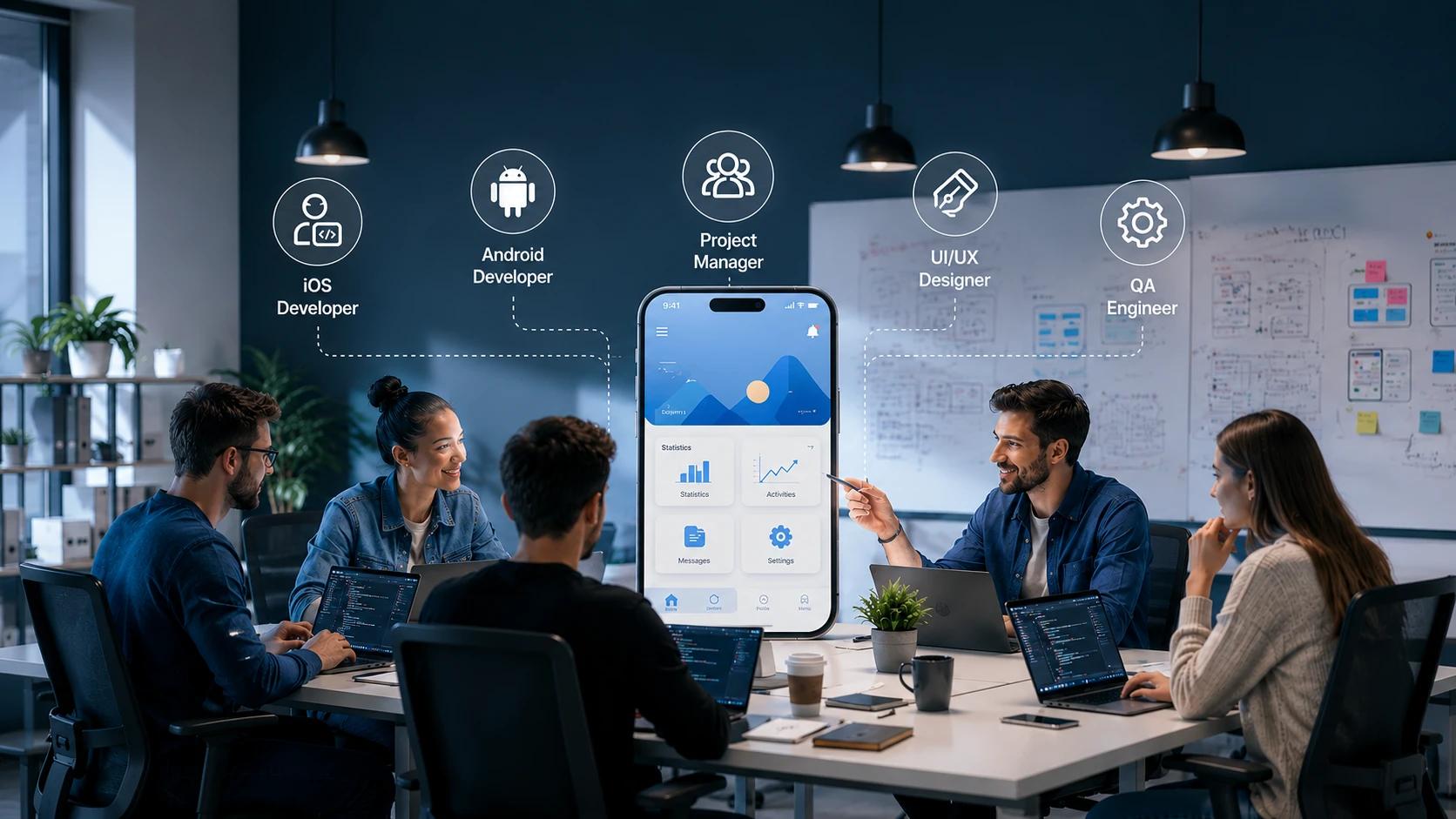
This team may include mobile developers, backend engineers, UX/UI designers, QA engineers, DevOps specialists, project managers, and product specialists. The exact composition depends on the app’s complexity and stage.
For example, an early-stage startup may need a small team with a product manager, designer, cross-platform developer, backend developer, and QA engineer. A larger enterprise product may need separate iOS and Android developers, backend engineers, DevOps support, QA automation, security expertise, and a delivery manager.
The main advantage is continuity. The team does not need to learn the product from zero every time a new feature is planned. They already understand the technical decisions, user flows, backend logic, and product priorities.
That knowledge saves time and reduces the risk of inconsistent development.
Dedicated Team vs Project-Based Mobile Development
Project-based mobile development works well when the scope is clear, the timeline is defined, and the goal is to deliver a specific version of the app. For example, a startup may hire a company to build an MVP, launch it, and then decide what to do next.
A dedicated team model is different. It is better when development is ongoing and the scope is expected to evolve.
Mobile products rarely stay unchanged after launch. Users request improvements. Analytics show weak points. Competitors release new features. Operating systems change. Business goals shift. A dedicated mobile development team allows the company to react faster because the team is already in place.
The difference is simple: project-based development is focused on delivery of a defined scope. A dedicated team is focused on continuous product growth.
Neither model is automatically better. The right choice depends on how active your roadmap is. If you need one clearly defined app version, a project model may be enough. If you expect monthly releases, ongoing product changes, and long-term scaling, dedicated mobile app developers usually make more sense.
When a Dedicated Mobile Development Team Makes Sense
A dedicated team becomes useful when the app is not just a side project but an important part of the business.
This often happens after the MVP stage. The startup has tested the idea, collected feedback, and now needs to improve the product quickly. At this point, hiring random developers for each new feature slows everything down. A dedicated team can keep momentum.
The model also works well for companies that already have a mobile app but need to modernize it, rebuild parts of the architecture, add new functionality, or improve performance. In these cases, the team needs time to understand the existing codebase and make changes without breaking the product.
Enterprise companies may need a dedicated mobile app development team when the app connects to internal systems, supports employees, or handles sensitive business processes. The product may require long-term maintenance, security updates, integrations, and continuous improvements.
A dedicated team is also useful when the company has an internal product team but not enough mobile expertise. Instead of hiring full-time employees in a competitive market, the business can extend its team with external mobile specialists.
When You Should Not Hire a Dedicated Team Yet
A dedicated team is not always the right first step.
If the product idea is still unclear, the budget is very limited, or the company only needs a small prototype, a dedicated team may be too much. In that case, discovery, prototyping, or a fixed-scope MVP may be a better starting point.
A dedicated model also requires involvement from the client side. The team needs product direction, priorities, feedback, and access to decision-makers. If the business is not ready to manage an active roadmap, the team may not be used efficiently.
For very small apps with no expected development after launch, a project-based model is usually enough. There is no need to maintain a full mobile app development team if the product will not change often.
The decision should be based on product maturity. If the product has a roadmap, users, business value, and ongoing development needs, dedicated developers can be a strong option. If the product is still only an idea, start smaller and validate first.
What Roles Are Usually Included in a Mobile App Development Team?
A dedicated mobile development team should be built around the needs of the product, not around a standard template.
For a cross-platform app, the team may include React Native or Flutter developers instead of separate iOS and Android specialists. For a native product, the company may need Swift developers for iOS and Kotlin developers for Android. If the app has complex business logic, backend engineers become just as important as mobile developers.
UX/UI design is also important because mobile products require clear user flows, not just attractive screens. QA engineers are needed to test features across devices, operating systems, user scenarios, and edge cases. For apps with cloud infrastructure, DevOps support may be required to manage deployment, monitoring, performance, and stability.
A project manager or delivery manager helps keep the team aligned, while a product owner or business analyst can help translate business goals into development tasks.
The strongest teams are not always the largest. A small but well-balanced team can move faster than a larger group with unclear responsibilities.
Dedicated Mobile Developers for Startups
Startups often begin with an MVP, but the real work starts after launch. Once users begin interacting with the product, the team has to improve onboarding, fix weak flows, add missing features, optimize retention, and prepare the app for growth.
A dedicated mobile app development team can help a startup move faster after validation. The team already understands the MVP and can continue improving it without losing context.
This is especially useful when the startup has investors, early users, or a short window to prove traction. Delays between releases can slow growth and weaken the product’s position in the market.
For startups, the dedicated team does not have to be large. A focused team with mobile development, backend support, UX/UI, QA, and project management can be enough to support active development.
The key is to avoid turning the team into a feature factory. Dedicated developers should not only build tasks. They should help the startup make better technical decisions, reduce unnecessary complexity, and prepare the product for the next stage.
Dedicated Mobile Teams for Enterprise Products
Enterprise mobile application development usually has different priorities than startup development. The product may need to support internal workflows, employee operations, customer portals, reporting, field teams, approvals, or integrations with existing systems.
In enterprise environments, the development team often has to work with legacy systems, security policies, role-based access, internal databases, compliance requirements, and multiple stakeholders. These products are rarely finished after the first release.
A dedicated mobile development team can support long-term enterprise needs because it stays familiar with the product, internal processes, and technical environment.
For enterprise apps, continuity is especially important. A new team may need weeks or months to understand how the systems connect. A dedicated team keeps that knowledge inside the project and reduces the cost of future changes.
This model also helps when the business wants to release improvements gradually instead of waiting for large, slow development cycles.
Dedicated Team for Native and Cross-Platform Apps
A dedicated mobile team can support both native and cross-platform development, but the structure will be different.
For native mobile apps, the team usually includes separate iOS and Android developers. This approach gives more control over platform-specific behavior, performance, and device features. It can be a strong option for complex apps, fintech products, healthcare platforms, or products where native performance matters.
For cross-platform mobile app development, the team may work with React Native or Flutter. This can be more efficient when the product needs to support both iOS and Android with a shared codebase. It is often a practical choice for MVPs, SaaS apps, marketplaces, fitness products, business apps, and internal tools.
The decision should not be based only on cost. It should depend on product complexity, performance requirements, timeline, long-term maintenance, and available expertise.
TopDevs provides iOS and Android app development services for companies that need native development, cross-platform development, or a dedicated team that can support both approaches.
How a Dedicated Team Helps Control Mobile Development Costs
A dedicated team may look more expensive at first than hiring developers for isolated tasks. But for active products, it can reduce long-term cost.
When the same team works on the product continuously, less time is wasted on onboarding, knowledge transfer, and re-explaining business logic. Developers understand the codebase and can estimate changes more accurately. QA engineers know common risk areas. Designers understand the product’s UX patterns. The project manager understands how the client makes decisions.
This continuity reduces rework. It also helps avoid inconsistent architecture, duplicated logic, and short-term technical decisions that create problems later.
Dedicated teams also make planning easier. The company can estimate monthly development capacity, prioritize the roadmap, and control what gets built next. Instead of negotiating a new scope for every small change, the team can work through planned sprints.
This does not mean cost control happens automatically. The client still needs clear priorities. But when the team and roadmap are managed properly, the dedicated model can be more efficient than constantly switching vendors or freelancers.
How Communication Works With a Dedicated Mobile Team
Communication is one of the main reasons dedicated teams succeed or fail.
The team should work with clear sprint planning, regular updates, demos, backlog management, and transparent task tracking. The client should know what is being built, what is blocked, what decisions are needed, and how the timeline is changing.
For US companies working with remote or nearshore developers, time zone overlap and clear English communication matter. A strong dedicated team should not feel like a black box. It should feel like an extension of the company’s product department.
Good communication also means honest technical feedback. If a feature is risky, the team should say so. If the scope is too large for the next release, the team should explain the trade-off. If a simpler solution can save time, the client should know.
The best dedicated mobile app developers do not only wait for tasks. They help the company build better software.
How to Know If Your Product Is Ready for a Dedicated Team
A product is usually ready for a dedicated team when it has a clear direction and enough work to keep the team productive.
This does not mean every detail must be planned for a year ahead. But the company should have a roadmap, active users or strong validation, a product owner, and a budget for continuous development.
If the app already has traction, a dedicated team can help improve it faster. If the MVP is validated, the team can help scale it. If the enterprise product has ongoing internal demand, the team can support new workflows and integrations.
A product is usually not ready for a dedicated team when the idea is still vague, stakeholders cannot agree on priorities, or there is no one available to make product decisions. In that case, discovery or MVP planning should come first.
The dedicated model works best when there is a balance: enough clarity to move forward, but enough flexibility for the product to evolve.
What to Ask Before Hiring Dedicated Mobile App Developers
Before hiring a dedicated mobile development team, the company should understand how the team will be formed, managed, and integrated into the product workflow.
It is important to know whether the vendor can provide the right specialists, how quickly the team can start, how communication will work, who manages delivery, how code quality is controlled, and how knowledge is documented.
You should also ask how the team handles changes in priorities. A dedicated model is flexible, but that flexibility needs structure. Without proper backlog management, the team can become busy without making meaningful progress.
Another important question is ownership. The client should have access to the codebase, documentation, infrastructure decisions, and project knowledge. A dedicated team should make the product stronger, not create dependency on hidden processes.
A reliable development partner will explain the model clearly and help choose the team size that fits the product stage.
Common Mistakes Companies Make With Dedicated Teams
One common mistake is hiring a team before the product direction is clear. Developers can build quickly, but if priorities change every week, speed does not create progress.
Another mistake is treating the dedicated team like a group of task executors instead of a product partner. If the team has no context about business goals, it cannot make useful technical suggestions.
Some companies also hire too many people too early. A larger team does not always mean faster delivery. If the product scope is not mature, a smaller senior team may be more effective.
A weak onboarding process is another problem. Even experienced developers need product context, access to documentation, technical background, and clear communication channels.
The dedicated model works best when the client and development team operate as one product unit, not as two separate sides passing tasks back and forth.
Dedicated Team vs Hiring In-House Developers
Hiring in-house developers gives full control, but it is expensive and time-consuming. In the USA, recruiting strong mobile developers can take months, and the cost includes salaries, benefits, management, retention, equipment, and onboarding.
A dedicated mobile app development team gives access to specialists faster. It also allows the company to scale the team up or down depending on product needs.
For startups and growing companies, this can be more practical than building a full internal department immediately. The business can keep strategy and product ownership in-house while using external development capacity for execution.
For enterprise companies, a dedicated external team can support internal departments when they do not have enough mobile expertise or when hiring internally is too slow.
The in-house model may become more attractive later, when the product is mature and the company wants full internal ownership. Until then, a dedicated team can provide speed and flexibility.
Choosing the Right Dedicated Mobile App Development Partner
The right partner should provide more than developers. It should help form the team, manage delivery, maintain code quality, and support long-term product growth.
Experience matters. A company that has worked with mobile products across startups, SaaS, fintech, healthcare, fitness, marketplaces, logistics, and enterprise applications is more likely to understand different product risks.
The partner should also be honest about the team structure. Not every project needs a large team. Not every product needs native development. Not every startup needs both iOS and Android from day one. A strong partner will help choose the setup that fits your budget and roadmap.
A good dedicated team should communicate clearly, document decisions, test regularly, and keep the product maintainable. The goal is not only to ship features. The goal is to build a mobile product that can grow without becoming harder to manage every month.
TopDevs provides dedicated mobile app developers for companies that need long-term mobile development capacity, product continuity, and scalable engineering support.
A Dedicated Team Makes Sense When the Product Has a Future
A dedicated mobile app development team is most valuable when the app is expected to grow. If the product has users, a roadmap, technical complexity, or regular business demand, continuity becomes important.
This model helps companies move faster, keep product knowledge inside the team, reduce onboarding waste, and support ongoing improvements after launch.
For a small one-time app, project-based development may be enough. For a product that will keep evolving, dedicated mobile app developers can become one of the most important parts of the business.
If your company needs a mobile app development team for native apps, cross-platform products, MVP scaling, enterprise mobile applications, or long-term product development, TopDevs can help build and support the right team structure.
Your idea - our execution. Let's create meaningful solutions together!
Contact ustags