Custom Mobile App Development by Industry: Healthcare, Fintech, Fitness, AI, and Enterprise Apps

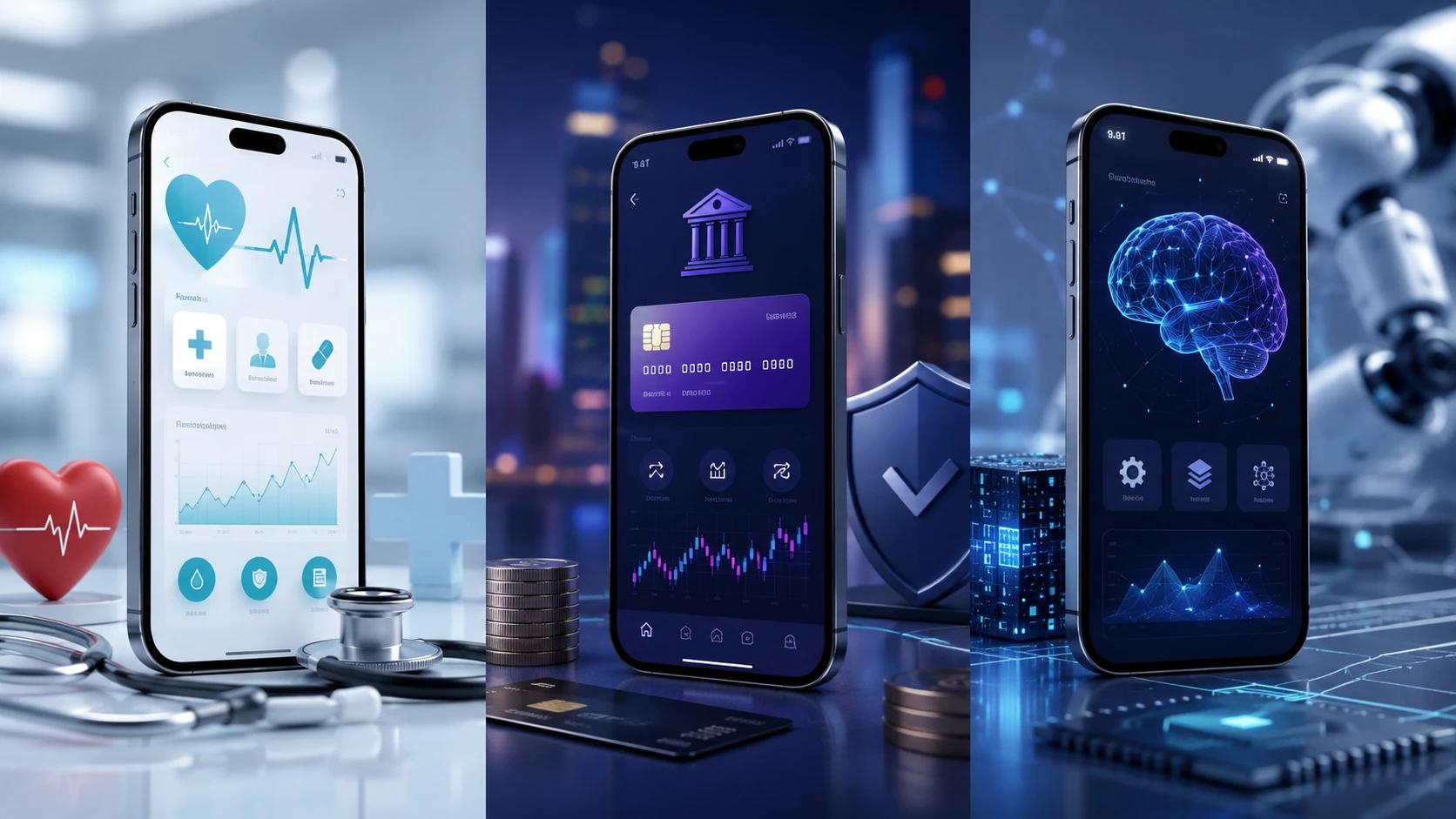
Custom mobile app development is never the same from one industry to another. A healthcare app, a fintech product, a fitness platform, an AI-powered mobile app, and an enterprise tool may all look similar on the surface because users interact with screens, buttons, profiles, and notifications. But behind the interface, the product logic, security requirements, integrations, and business risks are completely different.
This is why a generic approach rarely works for serious mobile products. A company that wants to build a mobile app should not only think about design, features, and development cost. It should also think about industry-specific workflows, user behavior, compliance, scalability, and the way the app will create business value.
For some industries, speed to market is the main priority. For others, security and reliability matter more. In some cases, the app has to support payments, identity verification, sensitive data, real-time tracking, AI-powered recommendations, or internal business operations.
This guide explains how custom mobile app development changes across different industries and what businesses should consider before building a mobile product.
TopDevs provides mobile app development services for startups, growing companies, and enterprise teams that need mobile products tailored to their industry, users, and business model.
Why Industry Context Matters in Mobile App Development
A mobile app is not only a technical product. It is a business tool shaped by the market where it will be used.
A healthcare app has to create trust and handle sensitive information carefully. A fintech app has to protect financial data and make every action feel secure. A fitness app has to keep users engaged over time. A logistics app has to work reliably in real-world conditions, often with maps, tracking, and field teams. An enterprise app has to fit into existing workflows instead of forcing employees to change how they work.
The industry defines the product logic. It affects onboarding, user roles, permissions, data structure, integrations, notifications, admin panels, reporting, and long-term maintenance.
This is also why copying features from competitors is not enough. Two apps may operate in the same industry but serve different business models. A healthcare marketplace, a telemedicine app, and a patient management tool all belong to healthcare, but they require different architecture and user flows.
A strong mobile app development team should understand this difference before writing code.
Healthcare Mobile App Development
Healthcare mobile app development requires careful planning because users often interact with sensitive personal information. Even when the app is not a full medical platform, trust and data protection matter.
A healthcare app may support appointment booking, patient communication, fitness tracking, treatment reminders, doctor-patient messaging, remote consultations, health records, or wellness programs. Each of these use cases creates different requirements.
The biggest challenge is not only building features. It is making the product safe, clear, and reliable. Users should understand what data they share, how the app works, and what actions they can take. Doctors, clinics, coaches, or administrators may need separate access levels and dashboards.
Security should be considered from the beginning. Authentication, encrypted data exchange, access control, audit logs, and secure backend architecture are not optional for serious healthcare products.
UX is also important. A healthcare app should not feel confusing or overloaded. Users may open it during stressful moments, while managing appointments, symptoms, treatment plans, or communication with specialists. The interface should reduce friction, not create it.
For healthcare startups, an MVP should usually focus on one core workflow. For example, appointment booking, remote consultations, patient tracking, or secure messaging can be tested before building a full ecosystem.
Fintech Mobile App Development
Fintech mobile app development is one of the most demanding categories because users trust the product with money, identity, and financial decisions.
A fintech app may include digital wallets, payment flows, budgeting tools, investment features, expense tracking, lending functionality, financial dashboards, card management, or identity verification. Even a simple-looking fintech app usually has complex logic behind it.
Security is the foundation. Users expect every transaction, login, balance update, and notification to be accurate. A small mistake can damage trust quickly.
Fintech products often require secure authentication, transaction history, payment gateway integration, fraud prevention logic, KYC-related flows, data encryption, and strong backend architecture. The app should also be designed to make financial actions feel clear and predictable.
UX in fintech is about confidence. Users should always know what is happening, what action they are taking, and what the result will be. Confusing flows can lead to abandoned transactions or support issues.
A fintech MVP should not try to become a full banking platform immediately. It is usually better to validate one specific use case first, such as expense tracking, peer-to-peer payments, financial planning, or one narrow investment workflow.
For fintech products, choosing a custom mobile app development company with experience in secure architecture and backend planning is especially important.
Fitness App Development
Fitness apps live or die by engagement. A user may download the app because of a workout plan, coach, challenge, wearable integration, or personal goal, but they continue using it only when the product becomes part of their routine.
A fitness app development company should understand more than mobile screens. It should understand habit loops, progress tracking, content delivery, subscriptions, personalization, and retention.
Fitness apps may include workouts, nutrition plans, progress charts, video lessons, wearable integrations, trainer dashboards, subscriptions, community features, reminders, and gamified achievements. But not every fitness product needs all of this from the first release.
The first version should focus on the main value. For one app, that may be guided workouts. For another, personal coaching. For another, progress tracking or AI-generated plans.
Design matters a lot in this category. The app should be easy to use during real situations: at the gym, at home, outdoors, or between exercises. Users should not struggle to find the next workout, track progress, or understand their plan.
Subscriptions are also common in fitness apps, which means the product has to show value quickly. If users do not feel progress, motivation, or convenience, they will cancel.
For startups, cross-platform mobile app development can often work well for fitness MVPs. It allows the business to launch on both iOS and Android, test retention, and improve the product based on real behavior.
AI Mobile App Development
AI mobile app development has become a strong direction for startups and established businesses, but it needs careful product thinking. Adding AI to an app does not automatically make it useful.
The first question should be simple: what decision, action, or user experience does AI improve?
AI can support recommendations, personalization, chat interfaces, image recognition, text generation, voice processing, predictive analytics, automation, and smart search. But every AI feature creates new product and technical questions.
The app may need third-party AI API integrations, custom model logic, data processing, user feedback loops, prompt management, usage limits, cost control, and privacy decisions. AI features can also increase infrastructure costs if they are used heavily.
UX is especially important because users need to understand what the AI can and cannot do. The app should not overpromise. It should make AI output useful, explainable, and easy to act on.
For an AI mobile app MVP, the best approach is usually to focus on one valuable AI-powered workflow. A broad AI assistant with too many unclear features can be harder to validate than a focused tool that solves one specific problem.
AI mobile app development also requires strong backend planning. The mobile interface may look simple, but the real complexity is often in data handling, API logic, response quality, user history, and cost management.
Logistics and Field Service Mobile Apps
Logistics and field service apps are built for real-world operations. They often need to work outside office environments, sometimes with unstable internet, moving users, time-sensitive actions, and location-based workflows.
These apps may support delivery tracking, route management, driver communication, task assignments, proof of delivery, inventory updates, GPS tracking, field reports, or dispatch dashboards.
Reliability is the key requirement. A beautiful interface is not enough if the app fails during a delivery, loses data, shows inaccurate location information, or makes field teams repeat the same task twice.
Offline mode can also be important. In some logistics and field service scenarios, the app should allow users to continue working even when the connection is weak, then sync data later.
The backend is usually complex because the app has to connect mobile users, administrators, customers, vehicles, orders, routes, and real-time status updates. This requires careful architecture.
For logistics products, development should start with workflow mapping. The team needs to understand how tasks move through the business, who updates what, and which actions are time-critical.
E-commerce and Marketplace Mobile Apps
E-commerce and marketplace apps are heavily influenced by user trust, speed, search experience, and conversion.
An e-commerce app usually has one business selling products or services. A marketplace connects multiple sides, such as buyers and sellers, clients and providers, hosts and guests, or brands and customers.
Marketplace development is usually more complex because the product has to support different user roles. Sellers may need listings, availability, pricing, messages, payments, and dashboards. Buyers need search, filters, profiles, reviews, checkout, and support. Administrators need moderation, reporting, dispute handling, and business analytics.
Mobile UX has a direct impact on revenue. Search should be fast. Product or service pages should be clear. Checkout should feel safe. Notifications should support user actions without becoming annoying.
For marketplaces, the MVP should usually focus on liquidity. The app has to prove that one side can find value from the other side. Advanced features are less important than solving the core exchange.
A custom app development team should help define which features are necessary to test this exchange and which can wait.
SaaS Mobile App Development
Many SaaS companies build mobile apps to extend their web platforms. In this case, the mobile app is not always the main product. It may support key workflows, improve retention, increase daily usage, or make the service more convenient for existing users.
A SaaS mobile app may include dashboards, notifications, reports, messaging, task management, collaboration, approvals, account settings, or quick access to core features.
The biggest mistake is trying to copy the full web platform into mobile. Mobile users usually need a simplified experience focused on the most important actions. The app should not become a smaller and more difficult version of the desktop product.
SaaS mobile development also requires strong API architecture. The app has to connect smoothly with the existing backend, user permissions, subscription logic, billing systems, analytics, and admin tools.
For SaaS companies, the mobile app should be planned around user behavior. What actions do users need to complete away from the desktop? What notifications are actually useful? Which workflows can be simplified on mobile?
The answers should shape the product, not the existing web interface.
Enterprise Mobile Application Development
Enterprise mobile application development is different from consumer app development. The app is usually built to improve internal operations, support employees, automate workflows, or connect teams with company systems.
Enterprise apps may support approvals, reporting, inventory, field operations, HR processes, CRM access, internal communication, document management, analytics, or role-based dashboards.
The challenge is that enterprise products must fit into existing systems. They may need integrations with ERP, CRM, accounting software, internal databases, identity providers, or custom business tools.
Security and access control are also critical. Different users may need different permissions, and the company may require audit logs, data protection rules, device policies, and secure authentication.
Enterprise UX should focus on efficiency. Employees use these apps to complete tasks, not to explore. The interface should reduce manual work, prevent mistakes, and make daily operations faster.
For enterprise mobile app development services, long-term support is often just as important as the first release. Companies need updates, maintenance, integration improvements, and feature expansion as internal processes evolve.
Why Custom Development Works Better for Industry-Specific Apps
Off-the-shelf tools can work for simple needs, but they often become limiting when the business has unique workflows, user roles, integrations, or monetization logic.
Custom mobile app development gives the company more control over product behavior. The app can be built around the real business process instead of forcing the business to adapt to generic software.
This matters most when the app is connected to revenue, operations, customer experience, or sensitive data. A fintech product, healthcare platform, logistics tool, enterprise app, or AI-powered mobile product usually needs more than a standard template.
Custom development also makes future scaling easier when it is planned properly. The architecture can support new features, new user roles, new markets, and deeper integrations.
The key is to avoid custom complexity where it is not needed. A good development team should know when to build from scratch and when to use proven third-party services for payments, authentication, analytics, notifications, maps, or AI APIs.
Choosing the Right Technology by Industry
The right technology stack depends on the product, not only the industry label.
Cross-platform mobile app development can be a strong choice for MVPs, SaaS products, fitness apps, marketplaces, e-commerce apps, and internal business tools. It can help launch faster on both iOS and Android while keeping development cost under control.
Native development may be better for apps that need high performance, advanced hardware access, complex animations, strict platform-specific behavior, or deeper system integration.
React Native app development services and Flutter app development services are often practical when the product needs a polished app for both platforms without building two separate codebases from the start.
For complex fintech, healthcare, AI, or enterprise products, the decision should be made after discovery. The team should evaluate security, integrations, scalability, user roles, performance requirements, and long-term maintenance before choosing the stack.
TopDevs provides mobile app development services USA businesses can use to build native and cross-platform apps based on real product requirements, not generic assumptions.
How to Plan an Industry-Specific Mobile App MVP
An industry-specific MVP should be narrow enough to launch but strong enough to test the real business idea.
The first version should focus on the core workflow. For healthcare, that may be booking, communication, or patient tracking. For fintech, it may be one secure financial action. For fitness, it may be a guided workout experience. For logistics, it may be task tracking or delivery status updates. For AI, it may be one intelligent feature that clearly improves the user experience.
The MVP should not try to represent the entire future product. It should prove whether the main use case works in the market.
This is where many businesses need discipline. Industry-specific apps often have many possible features, and every stakeholder may want something included. But every extra feature increases cost, timeline, testing effort, and maintenance.
A focused MVP helps the company learn faster. Once users validate the main workflow, the product can grow with more confidence.
Development Cost Depends on Industry Complexity
Custom mobile app development cost depends heavily on industry requirements.
A simple content or booking app may be relatively straightforward. A marketplace costs more because it has multiple user roles and transaction logic. A fintech app costs more because of security, payments, and financial data. A healthcare app may require stronger privacy decisions and secure communication. An AI mobile app may increase backend and infrastructure complexity. An enterprise app may require integrations with internal systems.
This is why asking “How much does an app cost?” is too broad. The better question is: what kind of app are we building, for which users, with which risks, and for which business process?
Cost is shaped by scope, platforms, UX/UI design, backend architecture, third-party integrations, security, QA, launch support, and post-launch maintenance.
A serious estimate should come after the team understands the product context. Without that context, the number is usually just a guess.
What to Look for in an Industry-Focused Mobile App Development Company
Choosing a development partner is not only about technical skills. The team should understand how to translate business workflows into mobile product logic.
A strong partner will ask about users, operations, monetization, compliance, integrations, internal teams, and long-term plans. They will not only ask for a list of features.
For industry-specific apps, relevant experience matters. A team that has worked with fintech, healthcare, fitness, logistics, AI, SaaS, or enterprise products is more likely to notice risks early.
The company should also be able to explain trade-offs. Should the app be native or cross-platform? Which features belong in the MVP? Which integrations are necessary for the first release? What can be simplified? What may become expensive later?
This kind of thinking is more valuable than simply agreeing with the initial idea. A good development partner helps shape the product before it becomes expensive to change.
Industry-Specific Apps Need More Than Generic Development
The best mobile apps are built around the realities of the industry they serve.
Healthcare apps need trust and secure data handling. Fintech apps need accuracy and confidence. Fitness apps need engagement. Logistics apps need reliability in real-world operations. SaaS apps need mobile workflows that support the larger product. Enterprise apps need integration with existing systems. AI apps need a clear reason for intelligence, not just AI as a feature.
That is why custom mobile app development should begin with business context. The team needs to understand who will use the app, what problem it solves, what risks exist, and how the product may grow after launch.
A generic mobile app may be enough for simple use cases. But when the app is tied to revenue, operations, security, or user trust, industry-specific development becomes much more important.
TopDevs can help companies plan, design, build, and scale custom mobile applications for healthcare, fintech, fitness, AI, logistics, SaaS, marketplaces, and enterprise use cases.
Your idea - our execution. Let's create meaningful solutions together!
Contact ustags