 Hanna VoronovaCEOUnited Kingdom
In today's hyper-competitive business landscape, maintaining strong customer relationships isn't just a nice-to-have – it's imperative. Organizations around the world are swiftly recognizing the power of customer relationship management (CRM) in fostering these connections, transforming their approach to customer interactions and reaping significant rewards. Yet, while there's a plethora of off-the-shelf CRM solutions available, many businesses find that these one-size-fits-all platforms often fall short in addressing their unique challenges and requirements.
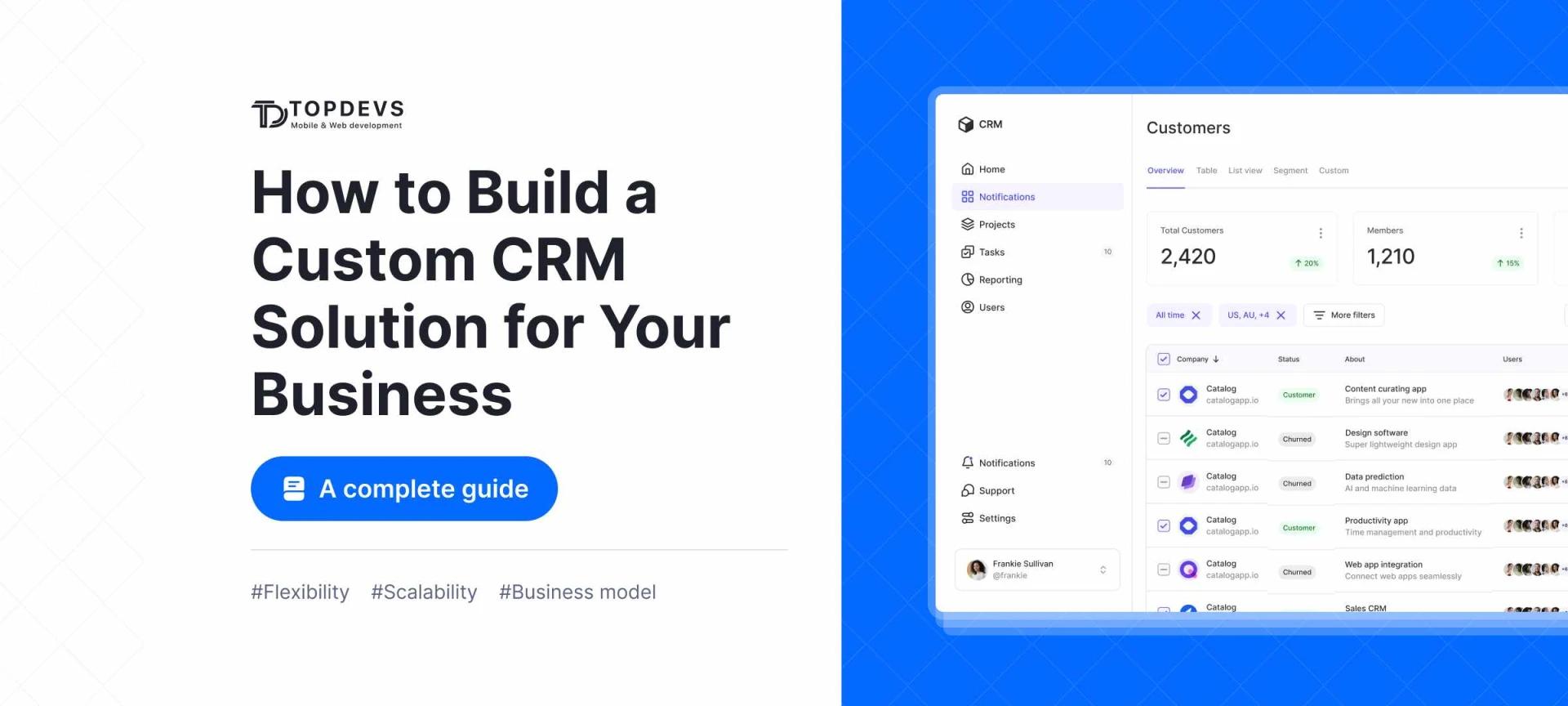
This leads to a pertinent question: Instead of adjusting your business processes to fit into a pre-built CRM system, what if the system was tailored to your specific needs? Enter custom CRM solutions – a bespoke approach that promises flexibility, scalability, and a snug fit to your business model. In this guide, we will journey through the intricacies of building a custom CRM, ensuring that it serves as a potent tool in your arsenal, amplifying customer relationships and driving business growth.
At its essence, Customer Relationship Management (CRM) software is a digital powerhouse designed to streamline and fortify the interactions, relationships, and data exchanges between a business and its customers. But it isn't just a digital address book or a glorified contact manager. Instead, a CRM system delves deep, capturing every touchpoint, every preference, every interaction, and more.
From the first email a potential lead opens to post-sales service interactions, a CRM captures this lifecycle, offering businesses invaluable insights. By centralizing this information, CRM software not only aids in maintaining and enhancing current relationships but also in predicting future trends and customer needs. It's an intricate dance of data and strategy, helping businesses nurture leads, close deals faster, and forge lasting, fruitful relationships with their clientele, all while providing a holistic view of their sales pipeline.

In an age where data reigns supreme and customer expectations continually evolve, CRM software emerges as a cornerstone for businesses aiming to thrive. But what exactly makes this tool indispensable? Firstly, CRM transcends being just software; it's a strategic asset. It unearths actionable insights from heaps of data, helping businesses tailor their approach to resonate genuinely with their audience.
Moreover, with a CRM system in place, businesses can enhance operational efficiency. Gone are the days of sifting through spreadsheets or shuffling between applications. Everything – from lead tracking to post-sales feedback – is centralized, reducing administrative burdens and fostering streamlined workflows. This cohesion not only improves team collaboration but also significantly reduces response times, giving businesses that crucial edge in customer service. Add to this the power of predictive analytics embedded in modern CRM systems, and businesses have a crystal ball, guiding them in foreseeing customer needs, optimizing marketing campaigns, and ultimately maximizing ROI. In short, investing in CRM software isn't just about upgrading technology; it's about future-proofing business growth and customer satisfaction.
Read also: Proof of Concept: 5 Steps for Successful App Development
By addressing these key areas, businesses can craft a CRM that not only serves their present needs but also anticipates future challenges.
Customer Relationship Management (CRM) systems, while unified in their core objective of improving business relationships, come in varied flavors, each designed to cater to specific needs. Understanding these types ensures that businesses can select or design a CRM solution that aligns perfectly with their operational model and strategic goals.
Here's a look at the primary CRM types:
By distinguishing between these CRM types, businesses can better identify the right tool that aligns with their specific objectives, whether it's operational efficiency, deep data insights, seamless collaboration, strategic engagement, or effective campaign management.
In today's digital landscape, the right CRM system is paramount for businesses. But amidst numerous options, what are the non-negotiable features? Here's a concise list:
Incorporating these pivotal features ensures businesses have a CRM solution that's not just powerful but also optimally aligned to their needs, fostering operational efficiency and enriched customer engagement.
Read also: The Product Vision Board: How to Create a Powerful Product Strategy
Navigating the intricacies of CRM software development can be challenging, but with TopDevs by your side, you’re equipped with seasoned insights. Here are our top tips to help you craft an outstanding CRM solution:
By adhering to these insights from TopDevs, businesses can ensure they're crafting a CRM solution that's not just functional and efficient but also remains a step ahead in the dynamic world of customer relationship management.
Embarking on the journey to build a custom CRM software can seem like a daunting task. But with a structured approach, the process becomes streamlined. Here's a seven-step roadmap to guide you in creating a stellar CRM system:
By following these steps, you’ll be on a sure path to crafting CRM software that's not just tailored to your business's unique needs but also stands the test of time in this dynamic digital landscape.
The investment in developing a custom CRM can vary widely based on several factors, with potential returns in business processes and customer engagement. Basic CRMs with essential features typically start from $20,000 to $50,000, while more complex systems with advanced integrations and features can exceed $150,000. Design, user experience, and the chosen tech stack can also influence the price, adding anywhere from $10,000 to $30,000. On top of the initial development cost, there are recurring expenses for maintenance, upgrades, and staff training, which can annually range from 10% to 20% of the original price. When considering all these variables, a comprehensive CRM solution might range from $50,000 to $250,000, though actual costs will hinge on specific needs and the chosen development partner.
Read also: Why Every Business Should Consider Creating a Generative AI Tool Like ChatGPT?
At TopDevs, we pride ourselves on our adaptability and our capability to meet unique client needs head-on. A testament to this is our recent project where we were tasked with crafting a CRM system tailored for the real estate sector. The challenge was to accelerate the development process and deliver a Minimum Viable Product (MVP) in record time, without compromising on functionality or quality.
Our client's vision wasn't just limited to a working prototype. They wanted a product that would not only be profitable and efficient in collecting user feedback but also flexible enough to seamlessly incorporate additional features in the subsequent phases. We charted out a strategic approach, breaking down the entire development process into three distinct milestones. This roadmap ensured that we stayed on track, allowing for iterative feedback, adjustments, and future expansion plans. Through dedication and expertise, TopDevs successfully delivered an MVP that encapsulated our client's vision, laying a robust foundation for future enhancements.
The realm of CRM software is constantly evolving, as businesses continually seek ways to cultivate richer relationships with their clients and streamline internal processes. In the coming years, we anticipate several groundbreaking changes that will redefine the landscape of CRM development.
Artificial Intelligence (AI) will play a pivotal role, in automating tasks, predicting consumer behavior, and offering insights to help businesses make data-driven decisions. Integrations with IoT devices are expected to usher in a new era of real-time customer data collection, bringing forth unprecedented customer insights. The increasing reliance on cloud-based solutions will ensure that CRM systems are more scalable, flexible, and accessible from anywhere, providing businesses with enhanced agility.
Moreover, CRM platforms will prioritize user experience, with intuitive interfaces, seamless integrations, and mobile compatibility. This will ensure businesses can engage with their customers more effectively, irrespective of the medium or device. As technology becomes increasingly personalized, CRM systems will adapt, offering hyper-personalized experiences tailored to individual user preferences and histories.
With these advancements on the horizon, the future of CRM software development promises to be dynamic, catering to a business ecosystem that’s smarter, more responsive, and profoundly customer-centric.
Crafting the perfect CRM solution for your business is no small feat, but with the right insights and strategic approach, it can be the linchpin of your company's success. From understanding the essence of CRM software and recognizing its invaluable impact to diving deep into its future trajectory, it's clear that a tailored CRM system is indispensable in the modern business ecosystem. By focusing on core features, embracing upcoming technological trends, and partnering with experienced developers like TopDevs, businesses can harness the full potential of CRM systems. As we look forward, it's not just about managing customer relationships anymore - it's about evolving with them, creating lasting bonds, and driving business growth in an ever-changing digital landscape.
Your idea - our execution. Let's create meaningful solutions together!
Contact ustags

What Is Website Development? Process, Planning, and Outsourcing Explained
February 3, 2026
How to Choose the Best Mobile App Development Company: A Step-by-Step Guide
February 5, 2026
5 Best iOS Design Patterns in Swift to Develop Powerful iPhone Apps
April 18, 2022