What Is The Difference Between E-Commerce And Mobile Commerce?


Online shopping and payment have made life much easier for people by completely changing the approach to selling. Traditional commerce still exists but is gradually giving way to e-commerce and mobile commerce.
E-commerce includes all transactions that are made from a PC, while mobility commerce includes transactions using mobility solutions only.
What Is E-Commerce?
E-commerce is the response of the economy when trade and financial transactions take place on the Internet. In simple terms, any transaction made from an electronic device connected to the network. It is enough to imagine your favorite shopping center, which has completely migrated into the virtual world, and all purchases are available only through Internet payment.
In addition, e-commerce also includes financial or trade transactions carried out using networks, but, what is important, a chain of constantly improving, global business processes associated with conducting transactions. E-commerce is the core of the rapidly developing digital economy in the world. This is the logical result of the explosive rates of development of telecommunication capacities over the past decade.
Moreover, there are several types of e-commerce:

What Is M-Commerce?
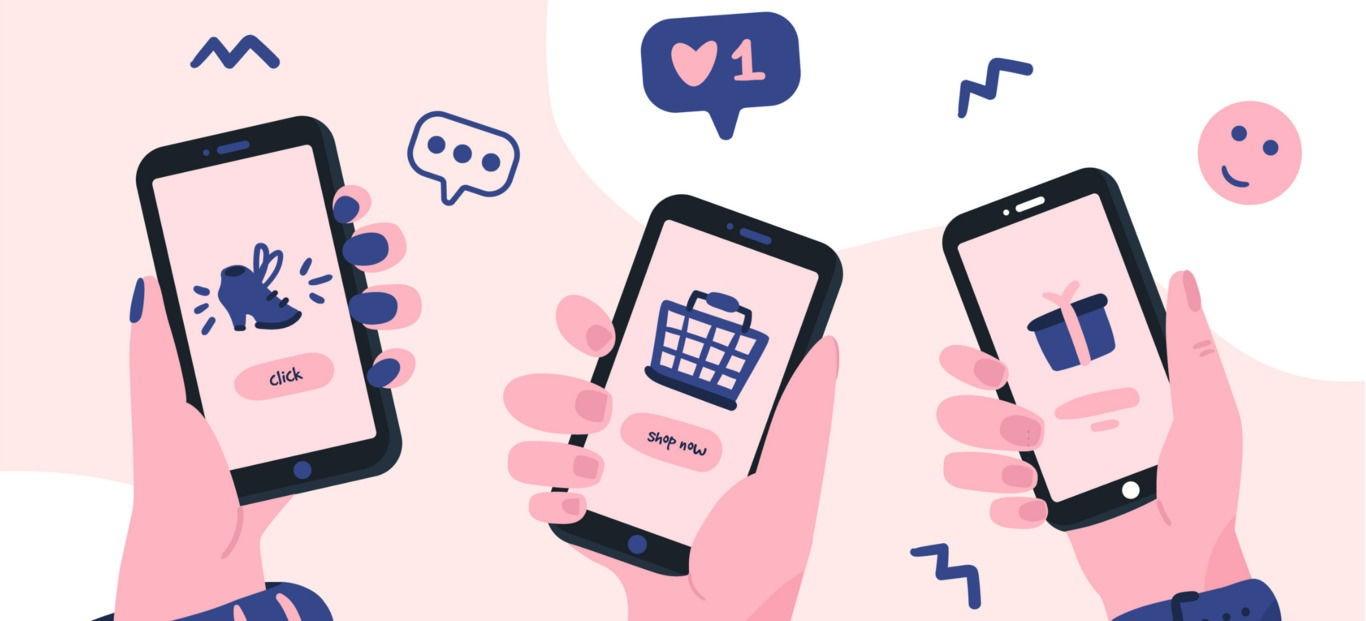
Mobile commerce is the buying and selling of goods and / or services through portable devices. Such sales can be made through sites, platforms or applications. In some degree, m-commerce can be called the subtype of e-commerce, that is concentrated on mobile devices, but this is not the whole structure.
M-commerce is used in the following areas:
- Telecommunications with changes and payments from a portable device.
- Mobile banking and any brokerage operations conducted from a portable device.
- Retailing and ordering and paying for services in the virtual space (for example, taking out insurance).
- Any information services that relate to the delivery of news updates and traffic updates to a mobile device.
On the technical side, most m-commerce platforms connect to a wireless network that allows you to shop online. As in e-commerce, in m-commerce, when conducting transactions, it is important to track a large number of indicators, from the average check to the traffic of a mobile application.
There are different types of mobile commerce:

Top Differences Between M-Commerce and E-Commerce
Despite the fact that e-commerce and m-commerce have the same goals of simplifying the consumer's life and making sales, they have some differences. Let's consider the top difference in commerce types.
M-commerce mobility
E-commerce means online shopping, but you need to be near your PC. M-commerce in this sense is more universal, you can literally use it. In addition, thanks to today there are a huge number of applications and mobile wallets that allow you to make purchases even through smart watches and other smart devices.
Availability and geofencing
M-commerce allows you to reach a customer literally anywhere, using data about their location tracking and data from using the device.
Read also: The Right Way to Build a Mobile App with Geofencing
The appropriate advertising setting allows you to attract a user and immediately sell him products or bring him to an offline point. In addition, you can get more customers by sending them promotional offers and leading them to purchase.
Sending notifications
The most important advantage of m-commerce. Push notifications are highly effective, especially when compared, for example, with emails that can be spammed or simply ignored. M-commerce delivers information faster, working more than 2 times better.
Comfort in conducting transactions
In e-commerce, transactions are performed primarily by credit or debit cards, as not everyone wants to save their payment details on websites. In contrast, m-commerce offers various payment options for goods and services. For example, instant transfers, UPI payments, and so on, which are traditionally considered more secure.
Omnichannel
If e-commerce is tied to a PC, which means that, for example, e-mail will be chosen as a communication channel, m-commerce will allow you to use SMS, email, notifications from applications, and much more. Diversity boosts conversions significantly.
Popular Examples of M-Commerce and E-Commerce
Let's consider the most common examples of e-commerce and m-commerce.
Among e-commerce, the following formats can be distinguished:
- Dropshipping, wholesale and retail trade in online stores.
- Coaching and courses that can be purchased and taken online.
- Crowdfunding platforms and various paid subscriptions.
Among m-commerce, the following formats can be distinguished:
- Telecommunications with changes and payments from a portable device.
- Mobile banking and any brokerage operations conducted from a portable device.
- Retailing and ordering and paying for services in the virtual space (for example, taking out insurance).
- Any information services that relate to the delivery of news updates and traffic updates to a mobile device.
Why M-Commerce is The Future: Market Overview
Three purchase decisions are made by searching for information on a mobile device. Any advertisement seen or heard on the street encourages the user to find and study information, and later come to a purchase.
M-commerce is constantly gaining its place in the market, and it is projected that by 2023, costs. This is also facilitated by an increase in the use of sites through mobile devices. About 80% of purchases on websites today come from mobile devices, and apps like Clubhouse and TikTok have proven that mobile apps can completely revolutionize sales and advertising.

A correctly and competently designed mobile application significantly increases conversion and helps to attract more users. This happens, first of all, due to the comfort of using the product. The business felt the particular relevance of mobile product development during the pandemic, when all sales were forced to go to the online world. Today, about half of the retailers have their own apps.
Benefits for Business With M-Commerce
M-commerce benefits for the user are variable, but let's look at the main benefits from a business perspective.
1. Everything happens faster
In addition to faster access, mobile versions of sites and applications often run faster than sites on a PC. Accordingly, the customer shopping experience will be positive, and repeat purchases will be made more often.
2. Improving the quality of customer service
By studying the statistics and reviews of the mobile application, you can constantly improve the service. Everything should be convenient, interactive, understandable and fast. In addition to customer retention, you will gain audience growth
3. Easy access to the client
Thanks to push notifications, you can always grab the user's attention, regardless of day or night. By setting up geofencing, you can attract a client who may not have known that your cafe is around the corner and right now you can get a discount on a business lunch.
4. Personalization of offers
Using data about the user and his behavior in the application, you can form an offer based on this information. This significantly increases positive customer experience and loyalty.
5. Lower costs for business
With commerce apps and all the resources that a mobile device provides, you can save on marketing strategies. In addition, in the mobile app, you can earn by placing ads.
Final Thoughts
In order to start making profit from presenting your business, you need to know your audience well and offer relevant offers. The site and the application should be responsive and user-friendly so that the use does not cause difficulties and discomfort for retailers consumers.
To achieve the desired result and apply best practices, you should contact the professionals in applications development. Supplement e-commerce with mobile commerce, analyze statistics and constantly improve.
Your idea - our execution. Let's create meaningful solutions together!
Contact ustags