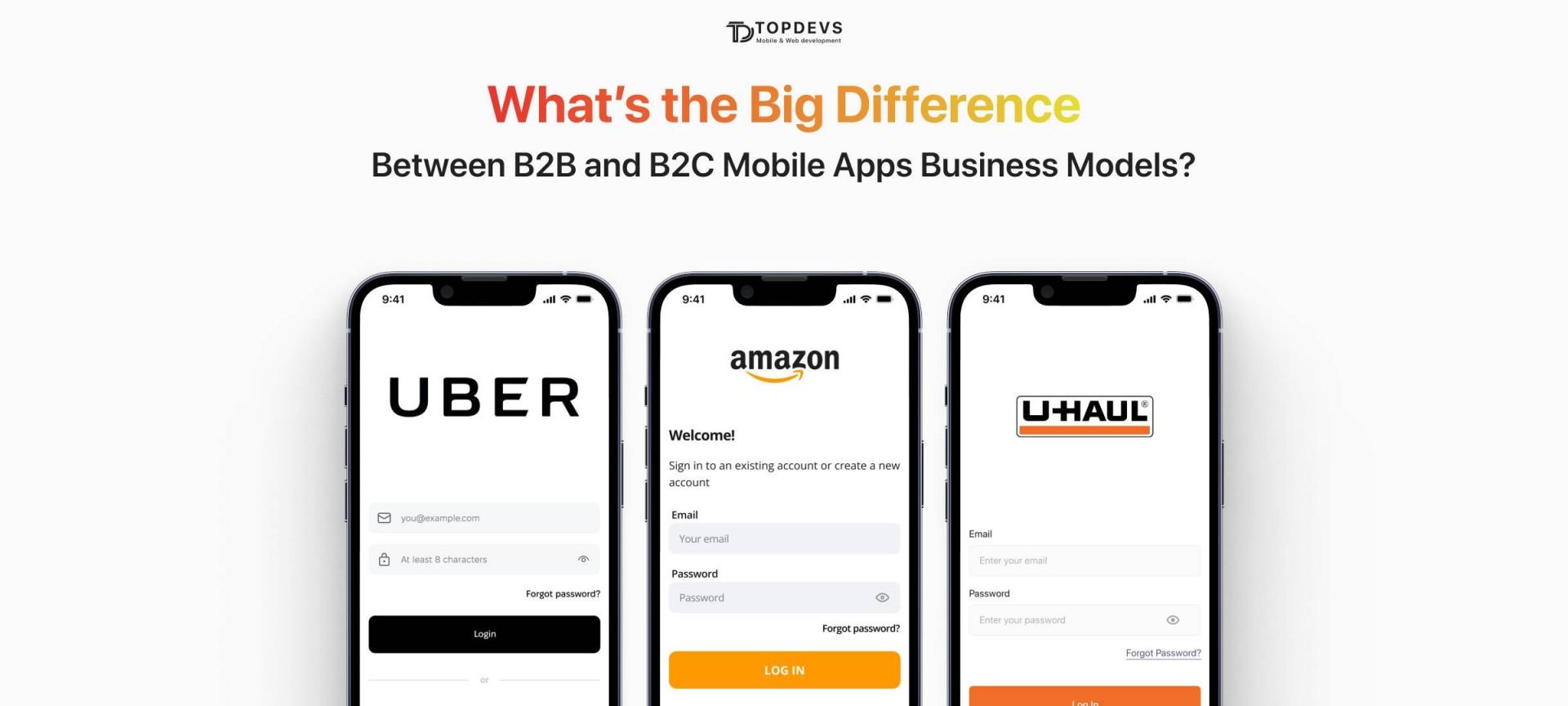
What’s the Big Difference Between B2B and B2C Mobile Apps Business Models?

It is challenging to imagine our modern life without mobile applications, they play a significant role in our personal and professional lives. Reaching success in this industry may be difficult, as the mobile app market is expanding rapidly, and so is demand. If you want to create your mobile app and reach a new audience, it's important to understand the critical difference between B2B (business-to-business) and B2C (business-to-consumer) apps. Let's look in detail.
What are B2B Applications?
B2B applications are created specifically for business needs. They typically offer functionalities that enhance productivity, efficiency, and management of various business processes.
The functionalities of such apps depend on the industry they target. They may include project management tools, customer relationship management (CRM) systems, inventory management systems, supply chain management solutions, collaboration platforms, data analytics dashboards, and more.
The key role of such applications is to streamline workflows, improve internal communication, improve customer communication, and increase sales. B2B applications help companies to stay competitive by managing their resources efficiently, automating key processes, and analyzing data to enhance decision-making.
Read also: How to Scale up a Consulting Company and Create Your Own SAAS Product
Pros and Cons of B2B Mobile Apps
B2B mobile apps are in high demand in many industries. You can monetize such apps through subscription models, licensing fees, and enterprise contracts. Indeed, they come with their own set of pros and cons.
Pros:
1. Enhanced productivity. B2B apps are perfect tools for improving business productivity. With their help, companies can increase teamwork efficiency, streamline business processes, automate tasks and analyze critical data more efficiently.
2. Enhanced revenue. B2B apps help businesses in cost savings. These applications can significantly lower operational costs and improve resource allocation by automating processes.
3. Better customer engagement. Such apps help companies to build strong relationships with clients by providing tools for proper customer support and delivering relevant content.
Cons:
1. Costly development process. B2B app development usually takes time due to complex processes and integration with existing systems such as CRM or ERP software. All of this increases the duration and cost of development and may impact app pricing.
2. Maintenance. B2B apps require continuous support and maintenance to address evolving business needs and ensure smooth operations.
3. High competition. The B2B application market is highly competitive, even in a niche industry with a small target audience. To stand out from the competition, you must invest a lot of resources, provide customers with exclusive features, and develop an effective marketing strategy.
What Are B2C Applications?

B2C applications are designed to serve the needs of consumers. These applications are used in a variety of industries: entertainment, social media, health, sports, travel, education, e-commerce, and many more.
A business-to-consumer app serves as a touchpoint between the company that provides the service and the customer. Such services can be online shopping, streaming, communication, productivity trackers, and others.
In B2C applications, special attention is given to creating a unique user experience. The design of such an app should be simple and intuitive. The application must adapt to users' needs and have flexible personalization settings.
Read also: How to Hire the Most Skillful Backend Development Team in the Industry
Pros and Cons of B2C Mobile Apps
B2C mobile apps can provide numerous functions and be used in different industries. These apps have a huge target audience that is quite easy to reach. You can also easily monetize B2C apps using many strategies. But let's dive deep into all pros and cons of such apps.
Pros:
1. Large target audience. Tablets, smartphones, and other smart devices are popular today, as do the B2C mobile apps. This guarantees a huge target audience in absolutely any, even niche industry.
2. Accessibility. B2C apps offer easy access to products, services, and information, enabling on-the-go transactions and seamless browsing experiences.
3. Monetization opportunities. B2C apps can be monetized through in-app purchases, advertising, subscription models, and other methods.
Cons:
1. High competition. High popularity means high competition, and the app market is full of offers for every taste. To stand out from your competitors, you need to offer your users a unique experience.
2. Constant maintenance. B2C apps require regular updates and improvements to capture user attention.
3. Management issues. Having a B2C app, you will encounter many comments, feedback, and questions. That requires effective feedback and support management to maintain a high rating for the application.
What are the Real Differences Between B2B and B2C Apps?

The difference between B2B and B2C applications is quite big. It starts with the target audience and ends with the development features. Based on our experience in developing similar applications, we have identified the following key differences between B2B and B2C projects:
- The target audience. B2B and B2C applications reach opposite target audiences. The average B2B application is aimed at business owners looking for reliable tools to streamline their workflow. And B2C applications are aimed more at the individual user who wants to purchase, looking for communication or entertainment.
- Marketing approach. Different target audiences require different advertising approaches. B2B marketing strategy includes attending industry conferences and networking events. In B2C application advertisements, the main focus is individual user experience, collaboration with influencers, etc.
- Development features. Due to the need to integrate with existing business systems, developing a B2B application can be more costly and complex than B2C.
How to Get Customers for B2B and B2C Mobile Apps
Reaching new customers for B2B and B2C mobile apps requires particular marketing strategies.
For B2B apps, we advise to:
- attend industry events
- establish partnerships
- implement referral programs
- use flexible subscription plans, and offer free trials
For B2C apps, we advise to:
- focus on app store optimization (ASO)
- collaborate with influencers
- use social media marketing
- provide regular updates
Read also: When Should You Update Your App? The Complete Guide on Apps Modernization
Is There a Difference in App Development Cost?

The costs of developing B2B and B2C mobile apps can differ due to complexity, customization, features, and platform compatibility. B2B app development cost depends on advanced functionalities and integration requirements. B2C app development costs may increase due to interactive features and platform adaptability.
On average, the pricing for B2B apps can vary between $16,000 to $100,000 and more. The B2C app development cost can start from $10,000.
TopDevs' Experience When Building B2B Apps
At TopDevs, we have experience in developing applications for businesses in various industries. We comply with the terms of the NDA and provide our clients with constant support during the development process.
In our portfolio, you will find many successful cases of creating B2B applications for real estate, logistics & tracking, retail & eCommerce, etc. With our skilled team of UI/UX designers, and iOS, Android, Frontend, and Backend developers, we have developed a payment processing app, management app, and many others for our clients from the USA, Canada, Australia, and Europe.
TopDevs' Experience When Building B2C Apps
Among our business-to-business app development experience, we also have a portfolio of successful B2C solutions. We're working with clients from the USA, Europe, and Canada. Our developed applications are used in e-commerce & retail, media & entertainment, dating, sports & fitness, and other industries.
By hiring our team to develop your B2C application, you will get experienced professionals in the:
- UI/UX design
- iOS development
- Android development
- Front end development
- Backend development
The End Point
The mobile app market can help you significantly expand your target audience. Their availability and simplicity are desirable to many users. However, to successfully launch your application, you should decide on the target audience that you want to reach. Understanding the critical difference between B2B and B2C applications will help you decide on the functionality you want to implement and plan a strategy for proper app advertising. You can attract new customers, expand your target audience and increase your revenue right now by hiring a team of experienced developers and creating a mobile application for your business.
Your idea - our execution. Let's create meaningful solutions together!
Contact ustags