
Staff Augmentation vs Managed Services: Which Model Is Right for Your Business?

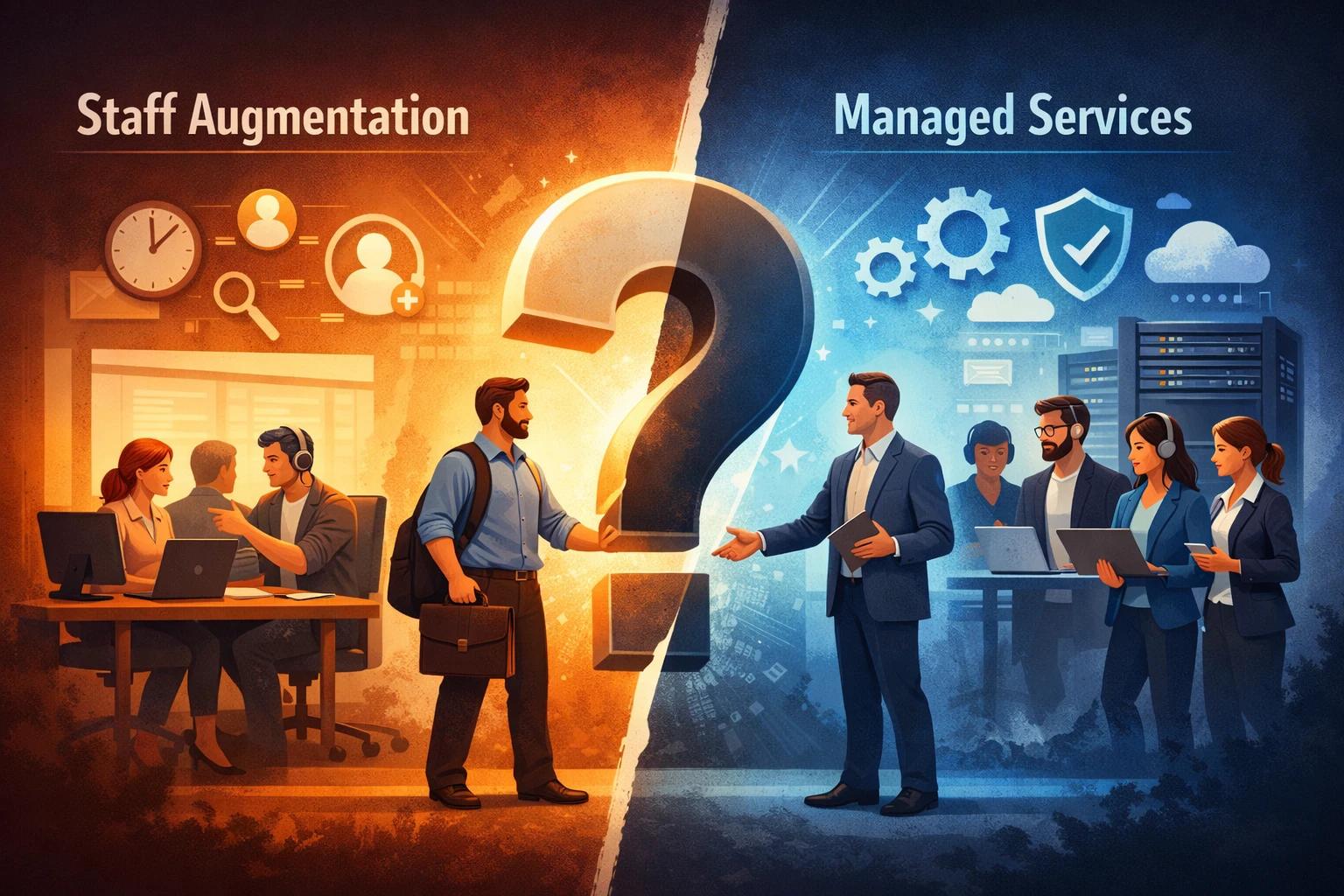
As businesses scale their digital operations, they often face the same strategic question: should we extend our internal team with external specialists, or should we fully delegate responsibility to an external provider? This decision usually comes down to choosing between staff augmentation vs managed services.
Both models are widely used across industries, and both can be highly effective when applied in the right context. However, they serve different purposes, require different levels of internal involvement, and lead to very different operational dynamics. Choosing the wrong model can slow down delivery, increase costs, and create management challenges.
This article provides a detailed comparison of staff augmentation and managed services, explains what is staff augmentation services, and helps you determine which approach aligns best with your business structure, technical maturity, and long-term goals.
What Is Staff Augmentation Services
To understand the comparison, it’s important to first clarify what is staff augmentation services. Staff augmentation is a cooperation model where businesses extend their internal teams with external specialists who work under the client’s direct management.
With staff augmentation services, companies retain full control over tasks, priorities, architecture decisions, and workflows. External professionals integrate into existing teams, use the same tools, and follow internal processes. From an operational standpoint, augmented specialists function as additional team members rather than an independent delivery unit.
An IT staff augmentation services model is especially common in software development, where demand for specific skills often fluctuates and hiring full-time employees may not be practical.
What Are Managed Services
Managed services represent a fundamentally different approach. Instead of extending internal teams, businesses delegate responsibility for specific functions or outcomes to an external provider. In this model, the provider manages people, processes, and delivery independently.
With managed services, the client defines objectives and service levels, while the provider decides how to achieve them. This model is commonly used for IT operations, infrastructure management, ongoing support, and sometimes full product development.
The key distinction is responsibility. In managed services, accountability for results lies primarily with the provider rather than the client’s internal team.
Core Differences Between Staff Augmentation and Managed Services
The difference between staff augmentation vs managed services goes beyond contract structure. It affects how teams collaborate, how decisions are made, and how risks are distributed.
Staff augmentation emphasizes control and flexibility. The client manages day-to-day work and directly influences technical decisions. Managed services emphasize delegation and predictability, shifting operational responsibility to the provider.
Understanding these differences is essential before choosing a model, especially for businesses with complex products or evolving requirements.
Control and Decision-Making
One of the most important distinctions lies in control. With staff augmentation services, the client retains full authority over development decisions. This model works well for companies with strong internal leadership and clear technical vision.
In managed services, control is shared or partially transferred. The provider is responsible for organizing work, assigning resources, and meeting agreed outcomes. This approach reduces management overhead but requires a high level of trust in the provider’s expertise.
Businesses that prefer hands-on involvement often gravitate toward staff augmentation, while those seeking operational simplicity tend to choose managed services.
Flexibility and Adaptability
Flexibility is another critical factor. IT staff augmentation services allow businesses to scale teams up or down quickly based on current needs. This makes augmentation ideal for projects with changing requirements or uncertain timelines.
Managed services are generally less flexible in the short term, as they are based on predefined scopes and service agreements. While providers can adapt over time, frequent changes may require contract adjustments.
For businesses operating in fast-changing markets, the ability to adapt quickly often makes staff augmentation the more attractive option.
Cost Structure and Budget Predictability
Cost considerations differ significantly between the two models. Staff augmentation costs are usually tied to hourly or monthly rates for individual specialists. This provides transparency but can lead to variability in total spend.
Managed services typically use fixed or subscription-based pricing. This structure offers predictability and simplifies budgeting, especially for ongoing operations. However, it may include a premium for risk transfer and provider accountability.
When comparing staff augmentation vs managed services, businesses should consider not just cost levels but also cost predictability and financial risk distribution.
Speed of Team Scaling and Delivery
Speed is often a decisive factor. Staff augmentation services enable rapid scaling by adding specialists to existing teams without lengthy hiring processes. This makes it possible to accelerate development or address bottlenecks quickly.
Managed services may require more time to initiate, especially when onboarding new projects or defining service scopes. However, once established, they can deliver consistent results with minimal client involvement.
For time-sensitive initiatives, staff augmentation often provides a faster path to execution.
Internal Management and Oversight Requirements
Staff augmentation requires active internal management. Clients must assign tasks, review work, and ensure alignment with business goals. This model works best when companies have experienced managers or technical leads in place.
Managed services reduce the need for internal oversight. The provider handles staffing, coordination, and delivery, allowing internal teams to focus on strategy rather than execution.
Businesses with limited management capacity often prefer managed services, while those with strong leadership benefit more from augmentation.
Risk Distribution and Accountability
Risk distribution is another major difference. With staff augmentation, the client assumes responsibility for outcomes, timelines, and quality. External specialists contribute skills, but accountability remains internal.
In managed services, the provider is accountable for meeting service levels and delivering results. This shift reduces internal risk but requires careful vendor selection and clear agreements.
Understanding where responsibility lies helps businesses choose a model that aligns with their risk tolerance.
Typical Use Cases for Staff Augmentation Services
Staff augmentation services are commonly used when businesses need to extend existing teams, access specialized expertise, or accelerate development temporarily.
Startups use augmentation to scale quickly without committing to long-term hiring. Enterprises use it to address peak workloads or introduce new technologies. In both cases, the model supports flexibility and control.
A reliable staff augmentation services company helps match skills to needs while minimizing onboarding friction.
Typical Use Cases for Managed Services
Managed services are well-suited for stable, ongoing operations where predictability and reliability are priorities. Common examples include IT infrastructure management, system monitoring, and long-term support functions.
This model is also effective when businesses want to outsource non-core activities while maintaining focus on strategic initiatives. Managed services providers offer standardized processes that reduce operational complexity.
For organizations seeking simplicity and reduced management overhead, managed services often provide strong value.
Role of a Staff Augmentation Services Company
A staff augmentation services company acts as a talent partner rather than a delivery vendor. Its primary responsibility is sourcing, vetting, and supporting specialists who integrate into client teams.
Beyond recruitment, some providers also offer staff augmentation consulting services, helping businesses define staffing strategies, identify skill gaps, and optimize team structures.
Choosing the right partner ensures that augmented specialists align technically and culturally with internal teams.
How to Decide Between Staff Augmentation and Managed Services
Choosing between staff augmentation vs managed services requires an honest assessment of internal capabilities. Companies should evaluate their ability to manage teams, define requirements, and oversee execution.
If control, flexibility, and rapid scaling are priorities, staff augmentation is often the better fit. If predictability, delegation, and reduced management effort are more important, managed services may be the right choice.
There is no universal answer - the optimal model depends on business context, maturity, and goals.
Hybrid Models and Combined Approaches
Many businesses adopt hybrid approaches, combining staff augmentation with managed services. For example, core development may be handled by augmented teams, while infrastructure or support functions are managed externally.
This combination allows companies to balance control and efficiency. Hybrid models are particularly effective for organizations with diverse needs across departments or products.
Flexibility in choosing and combining models often leads to better long-term outcomes.
Common Mistakes When Choosing a Delivery Model
One common mistake is selecting a model based solely on cost. Both staff augmentation and managed services can become inefficient if misaligned with business needs.
Another frequent issue is underestimating management requirements. Staff augmentation without proper leadership often leads to coordination problems, while managed services without clear expectations can result in dissatisfaction.
Clear objectives and realistic assessments help avoid these pitfalls.
Long-Term Impact on Business Growth
The chosen delivery model influences how teams scale, how products evolve, and how efficiently businesses operate. IT staff augmentation services support rapid growth and experimentation, while managed services provide stability and consistency.
Over time, the right choice improves operational efficiency, reduces risk, and supports sustainable growth. The wrong choice creates friction and slows progress.
Evaluating long-term implications is just as important as addressing immediate needs.
Choosing the Model That Fits Your Business Strategy
Ultimately, the decision between staff augmentation vs managed services should align with your broader business strategy. Technology delivery models are not just operational tools - they shape how organizations work and grow.
By understanding what is staff augmentation services, how managed services operate, and where each model excels, businesses can make informed decisions that support both short-term execution and long-term success.
In a competitive environment, choosing the right model is a strategic advantage rather than a tactical choice.
Your idea - our execution. Let's create meaningful solutions together!
Contact ustags