 Hanna VoronovaCEOUnited Kingdom
Choosing between native and cross-platform mobile app development is one of the first serious product decisions a company has to make. It affects cost, timeline, performance, scalability, user experience, and the way your product will be maintained after launch.
For some apps, native development is the safer long-term choice. For others, cross-platform development is more practical because it helps launch faster, reduce duplicate work, and support both iOS and Android with one codebase.
There is no universal answer. A fintech product, a healthcare app, a fitness platform, a marketplace, an AI-powered mobile app, and an internal enterprise tool may all require different technical decisions. The right approach depends on what the app should do, how complex the product is, how fast you need to launch, and how much flexibility you need after release.
This guide explains the difference between native and cross-platform mobile development, where each approach works best, and how to choose the right model for your product.
If your business needs help choosing the right stack and building a reliable product, TopDevs provides iOS and Android app development services for startups, growing companies, and enterprise teams.
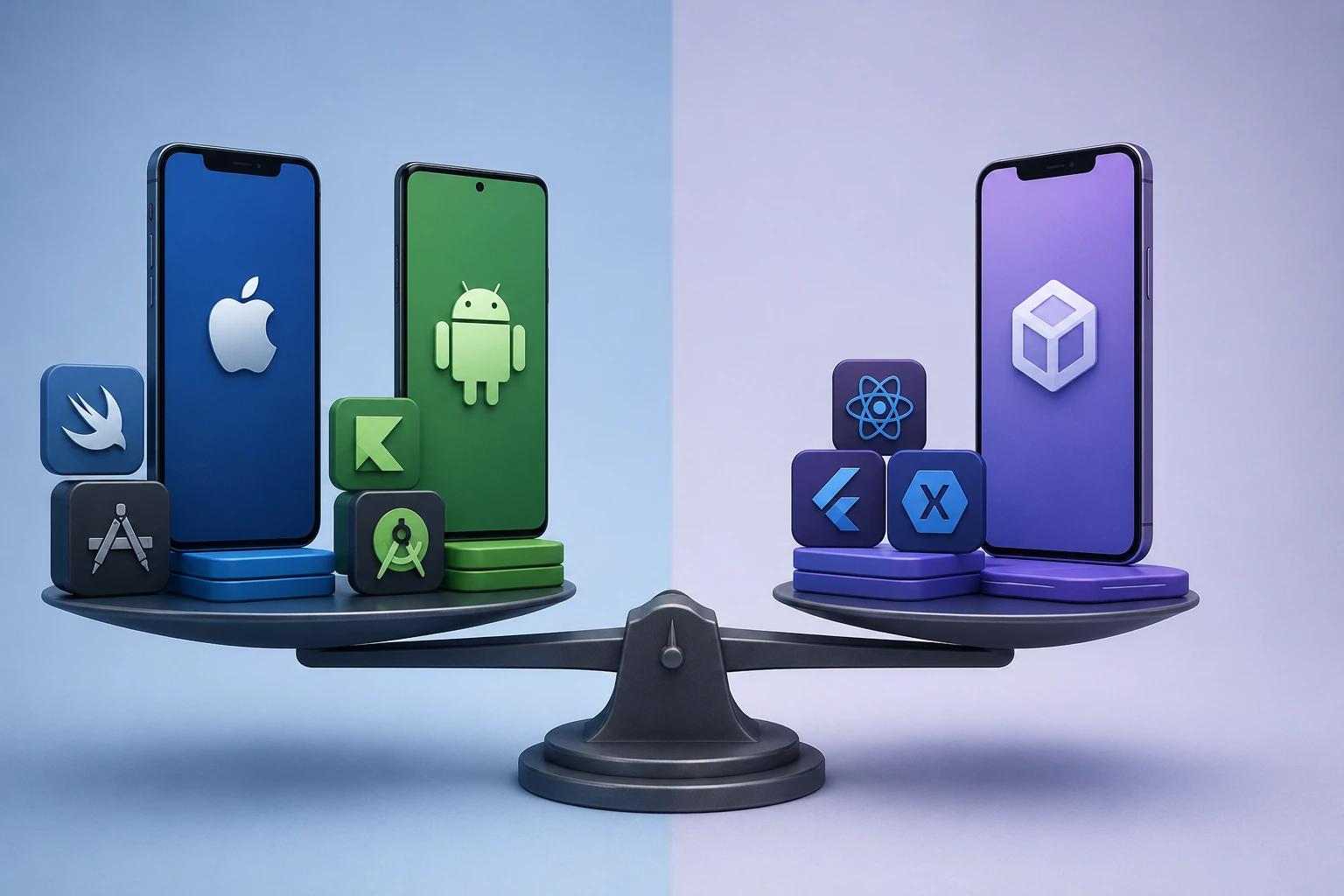
Native mobile app development means building a separate application for each platform. For iOS, developers usually use Swift or Objective-C. For Android, they usually use Kotlin or Java.
A native app is built specifically for the operating system it runs on. This gives developers direct access to platform features, device hardware, interface components, and performance tools. As a result, native apps can feel very smooth, stable, and natural to users.
This approach is often used for products where performance, reliability, security, or platform-specific behavior matters a lot. Examples include banking apps, healthcare platforms, video apps, navigation apps, apps with complex animations, and products that rely heavily on device features.
Native development gives teams maximum control. The trade-off is that building for both iOS and Android usually means developing and maintaining two codebases. That can increase cost, timeline, and long-term maintenance effort.
For companies with enough budget and a clear long-term product vision, native development can be a strong investment. For early-stage products, it may be more than the first version actually needs.
Cross-platform mobile app development means building one application codebase that can run on both iOS and Android. Instead of creating two separate apps from scratch, the team uses a shared framework such as React Native or Flutter.
The main advantage is efficiency. A shared codebase can reduce development time, lower initial cost, and make it easier to launch on both platforms at once. This is especially useful for startups, MVPs, SaaS products, marketplaces, content apps, business apps, and many customer-facing mobile products.
Cross-platform development does not mean the app is automatically low quality. A well-built cross-platform app can be fast, stable, and scalable. The result depends on the team’s architecture decisions, product complexity, testing process, and experience with the chosen framework.
The limitation is that cross-platform development may require additional native work when the app needs advanced device features, heavy animations, custom hardware integrations, or very specific platform behavior. In these cases, the team must understand both the cross-platform framework and the native layers behind it.
For many businesses, cross-platform mobile app development is a practical way to launch faster without building two separate products from day one.
The main difference is not only technical. It is strategic.
Native development gives more platform control. Cross-platform development gives more delivery efficiency. Native development is often stronger when the product needs maximum performance or deep platform integration. Cross-platform development is often stronger when the goal is to reach iOS and Android users faster with a controlled budget.
A native app is like building two specialized products for two different environments. A cross-platform app is like building one product that adapts to both environments.
Neither option is automatically better. The better choice depends on the product.
For example, a consumer fitness app with subscriptions, video content, progress tracking, and basic wearable integration may work very well with cross-platform development. But a medical device companion app that needs deep Bluetooth integration, strict reliability, and platform-specific behavior may be safer as a native app.
The mistake is choosing based only on trend, price, or personal preference. The right decision should come from product requirements.
Cost is one of the main reasons companies compare native and cross-platform development.
Native development usually costs more when both platforms are needed because the team has to build separate iOS and Android applications. Even when the design and backend are shared, mobile development work is duplicated to some extent.
Cross-platform development can reduce cost because much of the code is shared. One team can build the app for both platforms, which often makes the first release faster and more budget-friendly.
This is why React Native app development services and Flutter app development services are popular for MVPs and early-stage products. They allow companies to validate the idea, enter the market, and collect user feedback before investing in more complex platform-specific development.
However, cross-platform is not always cheaper in the long run. If the app later requires many native modules, advanced animations, deep hardware features, or complex platform-specific behavior, the cost advantage can shrink.
The smartest approach is to estimate the product realistically. For a simple or medium-complexity app, cross-platform development may save time and budget. For a complex product with high technical demands, native development may reduce risk and rework later.
Speed matters when a company needs to validate an idea, launch before competitors, or support both iOS and Android users quickly.
Cross-platform development usually gives an advantage here. A shared codebase means the team does not need to build the same feature twice for two platforms. This can make the development process faster, especially for MVPs and products with standard mobile functionality.
For startups, this can be critical. The first version of the app should help test demand, understand user behavior, and prove the product direction. Spending too much time on separate native builds before validation can slow the business down.
Native development may take longer, but it can be worth it when the app has complex requirements from the beginning. If the product needs advanced performance, strict security, platform-specific design, or deep device functionality, native development may prevent problems that would appear later with a less suitable approach.
Time to market should not be confused with rushing. A fast launch is valuable only if the app is stable enough to create real user feedback.
Native apps usually have an advantage in performance because they are built directly for the platform. They can access platform APIs more naturally and use device resources more efficiently.
This can matter for apps with heavy graphics, complex animations, real-time processing, video editing, advanced maps, high-frequency data updates, or hardware-dependent functionality.
For many business apps, marketplaces, SaaS tools, content products, and standard consumer apps, cross-platform performance is usually enough when the app is built properly. Users will not care what framework was used if the app opens quickly, responds smoothly, and does not crash.
Performance problems often come less from the framework and more from poor architecture, inefficient backend calls, weak testing, or badly optimized screens.
That said, if your product depends heavily on speed, low latency, complex native interactions, or advanced mobile hardware, native development should be seriously considered.
iOS and Android users have slightly different expectations. Navigation, gestures, permissions, notifications, interface patterns, and system behavior are not identical.
Native development makes it easier to follow platform-specific standards. The app can feel more natural because it uses components and behaviors designed for each operating system.
Cross-platform apps can also deliver a strong user experience, but the team has to be careful. A lazy cross-platform implementation may feel generic. A good one respects the differences between platforms while still benefiting from shared code.
For products where brand consistency matters more than strict platform-native behavior, cross-platform development can work well. For apps where platform precision is part of the experience, native development may be better.
The user does not think in terms of native or cross-platform. The user notices whether the app feels fast, clear, predictable, and easy to use.
The long-term maintenance model is one of the most important differences.
With native development, you maintain two separate mobile codebases. That gives flexibility, but it also requires more coordination. A feature released on iOS must also be built on Android. Bugs may appear differently on each platform. Updates may need two separate implementation flows.
With cross-platform development, shared code can make maintenance easier. Many updates can be made once and deployed to both platforms. This is useful for teams that want faster iteration and simpler product management.
However, the shared codebase must be clean. If the app grows without proper architecture, cross-platform maintenance can become difficult. The same is true for native apps. Bad structure creates problems in any technology.
Scaling is less about the framework and more about engineering discipline. A scalable app needs good backend architecture, clean code, testing, documentation, monitoring, and a clear release process.
This is where working with an experienced custom mobile app development company becomes important. The team should not only build the first version. It should also think about what happens when the product has more users, more features, and more business pressure.
React Native and Flutter are two of the most common options for cross-platform mobile development.
React Native is often a strong choice when the product team already works with JavaScript or React. It can be practical for startups, SaaS products, marketplaces, internal tools, and apps that need fast development across iOS and Android.
Flutter is known for flexible UI development and consistent visual experience across platforms. It can be useful when the design is highly custom or when the team wants strong control over how the interface looks and behaves.
The choice between React Native and Flutter should not be made only by popularity. It should depend on the product, existing team skills, required integrations, design needs, performance expectations, and long-term maintenance plan.
A reliable mobile development company should not push one framework for every project. It should explain why a specific stack makes sense for your case.
Native development is usually the stronger choice when the app needs maximum control, advanced performance, or deep integration with the device.
This often applies to complex fintech apps, healthcare products, video-heavy platforms, navigation apps, apps with advanced Bluetooth or IoT integration, products with complex animations, and enterprise applications with strict security or compliance needs.
Native can also be the better option when the company already knows the product will become large and platform-specific. If iOS and Android versions will eventually require different behavior, separate native apps may be easier to manage.
The higher initial cost can be justified when reliability, precision, and long-term technical flexibility matter more than the fastest possible launch.
Cross-platform development is often the better choice when the business needs to launch on both iOS and Android quickly, control the budget, and validate the product before investing in separate native apps.
It works especially well for MVPs, startup products, SaaS apps, marketplaces, e-commerce apps, content platforms, fitness apps, booking apps, and internal business tools.
For many companies, the first version does not need every possible native feature. It needs to solve a clear user problem, look professional, work reliably, and reach the market fast enough to generate feedback.
That is where cross-platform development can be very effective. It helps companies avoid building two separate products before they know exactly what users need.
TopDevs provides cross-platform mobile app development for businesses that want to launch scalable iOS and Android applications with a practical development budget.
For MVPs, cross-platform development is often the most practical option.
The goal of an MVP is not to build the most complete version of the product. The goal is to test the most important assumption. Will users sign up? Will they complete the key action? Will they pay? Will they return? Will the business model work?
A cross-platform MVP can help answer these questions faster because the team can build once and release on both platforms. That does not mean quality should be low. A good MVP should still be stable, usable, and technically clean enough to evolve.
Native development may still make sense for an MVP if the core idea depends on native performance or device-specific features. For example, if the app’s main value comes from advanced camera processing, real-time sensor data, or platform-specific interactions, native may be the right choice even for the first version.
The decision should come from the core product risk. If the risk is market validation, cross-platform is often enough. If the risk is technical feasibility, native may be safer.
Enterprise mobile application development has different priorities. Speed and cost still matter, but security, reliability, integrations, access control, and long-term support are often more important.
Cross-platform development can work well for many enterprise apps, especially internal tools, dashboards, field service apps, reporting apps, and workflow management products. These apps often need to run on both iOS and Android while sharing similar business logic.
Native development may be better when the enterprise app requires deep device control, strict offline behavior, advanced security, or heavy integration with platform-specific tools.
Enterprise decisions should also account for maintenance. If the company wants one internal product across many teams and devices, cross-platform may reduce long-term complexity. If different departments need different platform-specific behavior, native development may be more flexible.
The right answer depends on the real use case, not on the label “enterprise.”
Security does not depend only on native or cross-platform development. A native app can be insecure if built poorly. A cross-platform app can be secure if the architecture is strong.
Security depends on authentication, data storage, encryption, API protection, backend architecture, access control, session management, logging, infrastructure, and testing.
That said, certain security-sensitive apps may benefit from native development when deep platform-specific protections are required. Fintech, healthcare, insurance, and enterprise products should always treat security as an architectural requirement, not as a feature added later.
For most apps, the backend and API layer are just as important as the mobile code. If the server side is weak, the app will remain vulnerable regardless of the mobile framework.
The best way to choose between native and cross-platform development is to look at the product from several angles.
If your main priority is fast launch, controlled budget, and availability on both iOS and Android, cross-platform development is often the stronger first choice. If your main priority is advanced performance, complex hardware features, or platform-specific behavior, native development may be better.
If the product is an MVP, cross-platform usually deserves serious consideration. If the product is a complex, long-term platform with demanding technical requirements, native development may be worth the larger investment.
The decision should also consider your team. If you already have internal React developers, React Native may be a practical option. If your team has strong native expertise, separate iOS and Android development may be easier to control.
A good development partner should help you compare these options honestly. The answer should not be based on what the company wants to sell. It should be based on what your product needs.
For most companies, the decision becomes clearer when you define the first version of the app.
If the first version needs user registration, profiles, payments, notifications, content, simple messaging, booking, dashboards, or marketplace functionality, cross-platform development may be enough. It can reduce time to market and keep the budget realistic.
If the first version needs advanced graphics, complex real-time processing, deep hardware access, strict platform-specific behavior, or very high performance, native development may be safer.
The key is not to overbuild too early. Many businesses choose native development because it sounds more serious, even when the first version does not need it. Others choose cross-platform because it sounds cheaper, even when the product is technically too demanding.
Both mistakes can become expensive.
TopDevs helps companies choose the right mobile stack based on product goals, budget, timeline, and technical requirements. As a team providing custom mobile app development services, we can support native iOS, native Android, and cross-platform development depending on what the product actually needs.
Native development and cross-platform development both have strong use cases.
Native is often better for complex, performance-heavy, platform-specific, or highly secure products. Cross-platform is often better for MVPs, business apps, SaaS products, marketplaces, and companies that need to launch on both iOS and Android faster.
The right decision should balance product goals, technical requirements, budget, timeline, and long-term plans. A strong mobile app development team will not force one approach. It will explain the trade-offs and help choose the path that gives your product the best chance to succeed.
If you are planning a mobile product and need help choosing between native and cross-platform development, TopDevs can help design, build, launch, and scale your iOS and Android application.
Your idea - our execution. Let's create meaningful solutions together!
Contact ustags

Animations in UI Design: Types, Principles, Benefits
June 15, 2021
Kotlin vs. Java: Which is Better for Android App Development?
August 9, 2022
How Technologies Advance Inbound and Outbound Logistics
September 20, 2022